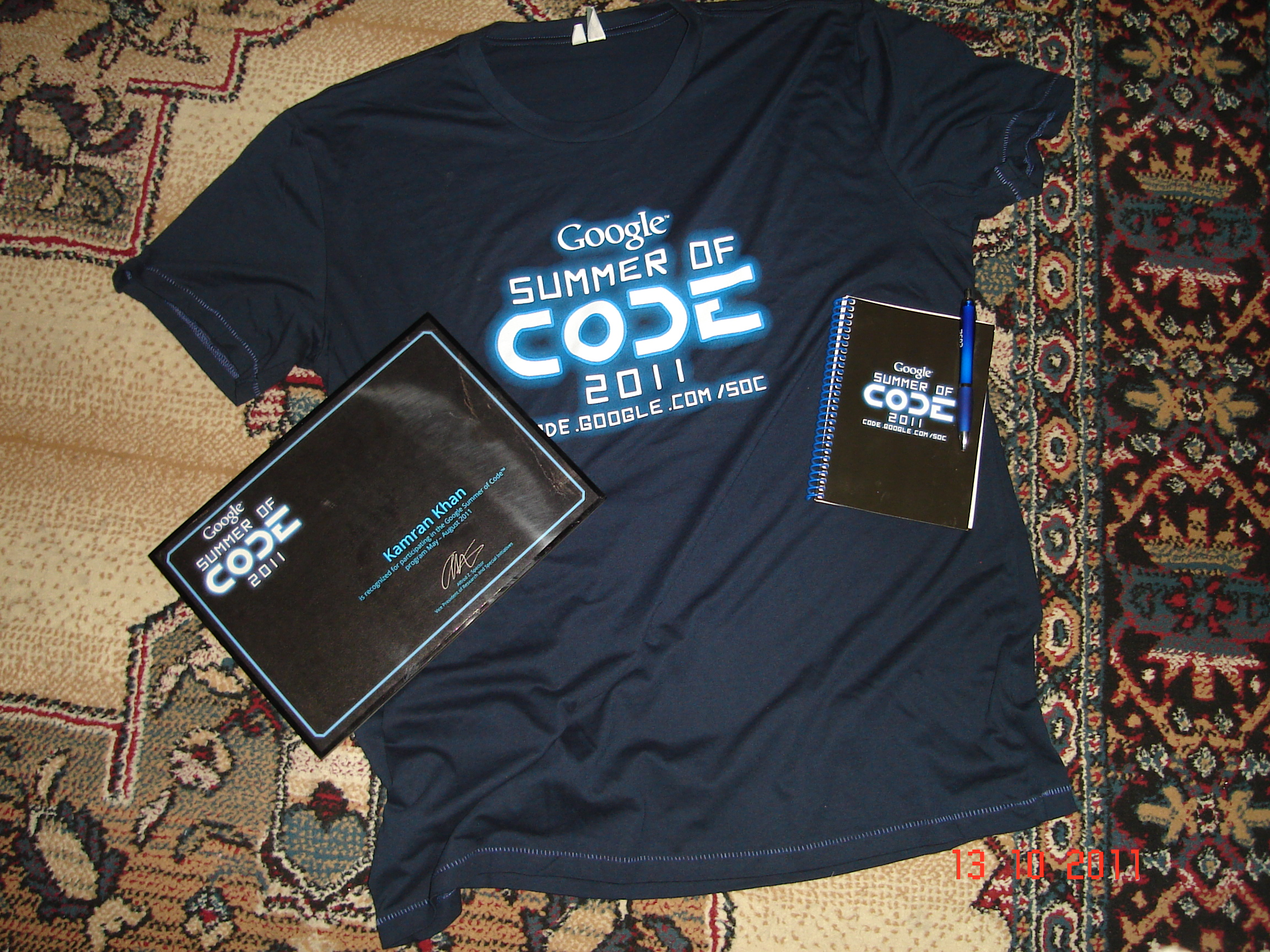


As eleven weeks of the-best-summer-ever draw to an end, here’s the final coding report for GSoC 2010.
Related Links
Time Spent
60 hours.
Highlights
The week was spent mostly cleaning and packaging the code accumulated over the summer. To demonstrate some of the aspects of the Arsenal library, I also created a proof-of-concept CGI script which upstreams Launchpad attachments for a bug to a remote Bugzilla. The task was fun, as the efforts put into refactoring things into launchpadlib-toolkit and BugzillaAdapter finally paid off and it took only a few hours to get the script working (that too with most of the time spent learning AJAX).
Concerns
None.
Waiting Items
None.
Stalled Items
None.
Accomplishments
- Branch, Merge Revision:
- Revision: Added support for quilt.
- Revision: Added support for using patch utility for quilt packages where the diff files update debian/* stuff themselves.
- Revision: Cleaned up the library to provide
LaunchpadApplication and LaunchpadBugzillaApplication.
- Revision: Fixed
BugPatcher to use LaunchpadApplication as base class.
- Revision: Cleaned up
LaunchpadBugzillaApplication to take username password as arguments instead of modifiers.
- Branch, Merge Revision: Fixed packaging issues to release
debs for Karmic and Lucid.
- Branch: Implemented a CGI script demonstrating the upstreaming capabilities of Arsenal library. An example run can be seen in this screencast.
Minor Tasks
- Revision: Some more code cleanup.
- Revision: Check
launchpadlib version before appending ‘/beta‘ during API URL detection.
Actions for the Following Report
- Fill the final evaluation.
- Write a summary of the overall GSoC experience.
- Start waiting for the t-shirt.
Tags:
AJAX,
API,
Arsenal,
Bugzilla,
Code,
Curl,
Debian,
GSoC,
Launchpad,
Open Source,
Python,
Rants,
REST,
Ubuntu,
XML-RPC
Related Links
Time Spent
60 hours.
Highlights
New features were added to Attachment Upstreamer in order to make it more suitable for issues encountered by Ubuntu maintainers (as suggested by Bryce from his experience as the X.org maintainer).
Concerns
None.
Waiting Items
None.
Stalled Items
None.
Accomplishments
- Branch, Merge Revision: Implemented caching of Bugzilla credentials using Gnome Keyring and
ConfigParser.
- Merge Revision:
- Branch: Added support for excluding attachments based on filename matching using glob patterns.
- Branch: Added support for extracting Tar and Zip archives when the number of files in them is below a specified limit.
- Branch: Added support for excluding attachments based on their sizes, optionally Gzipping them in an effort to make the size acceptable.
- Branch: Added support for enforcing content-types of attachments based on their filenames.
Minor Tasks
- Various bugfixes and code-cleanup for previously merged GSoC code.
Actions for the Following Report
The Launchpad and Bugzilla sides of the Upstreamer are to be cleaned up and made dependent on launchpadlib-toolkit and BugzillaAdapter respectively. This will help future scripts which rely on Bugzilla communication as well as make such things agnostic to the implementation lying beneath the adapter (e.g., whether we’re using Curl/XML-RPC/REST to talk to the server).
Tags:
API,
Arsenal,
Bugzilla,
Code,
Curl,
GSoC,
Launchpad,
Open Source,
Python,
Rants,
REST,
Ubuntu,
XML-RPC
Firefox 4 offers some compelling features such as HTML 5 improvements and a new add-on manager. Since it’s quite painstaking to compile the beta from source and quite messy to place pre-compiled binaries in system default folders (not to mention the compatibility checks and upgrade chores that would interrupt at each launch if you go back and forth between different versions), I created a repository at repo.inspirated.com which can be used to test the beta version without touching any 3.6 stable release already installed on the system:

To use the repository, issue the following commands:
$ su -c 'wget http://repo.inspirated.com/inspirated.repo -O /etc/yum.repos.d/inspirated.repo'
$ su -c 'yum install firefox-beta'
The beta refuses to run if an instance of old Firefox is already active. Therefore, close the older Firefox and then launch the 4.0b1 version using firefox-beta command or the “Firefox Beta” shortcut in the applications menu. A new profile shall be created at ~/.mozilla/firefox/beta/ in order to leave your older profile’s settings, bookmarks and extensions etc. intact.

(Click on the thumbnail for larger version.)
Tags:
Beta,
Fedora,
Firefox,
Open Source,
Repository,
RPM,
Technology,
Yum
Related Links
Time Spent
50 hours.
Highlights
The send-attachments-upstream.py script was migrated from XML-RPC to Curl for communicating with Bugzilla. The script was the refactored in order to provide capabilities such as attachment filtering. Various bugfixes and improvements were catered to along the way.
Concerns
None.
Waiting Items
None.
Stalled Items
None.
Accomplishments
- Branch, Merge Revision: Reimplemented attachment sending using
pycurl.
- Branch, Merge Revision: Refactored the script in order to provide options such as
-o (copy only attachments uploaded by bug owner).
Minor Tasks
- Branch, Merge Revision: Fixed regular expressions for parsing results and handling of Unicode attachment titles.
Actions for the Following Report
Implement the following improvements in send-attachments.py:
- Caching Bugzilla credentials.
- Filename exclusion for attachments.
- Archive extraction.
- File size limits.
- A command-line switch to enforce MIME content-types based on file extensions.
Tags:
API,
Arsenal,
Bugzilla,
Code,
Curl,
GSoC,
Launchpad,
Open Source,
Python,
Rants,
REST,
Ubuntu,
XML-RPC
Related Links
Time Spent
10 hours.
Highlights
Communicating with Bugzilla is done through the python-bugzilla wrapper library. This could have been achieved by using xmlrpclib directly but doing that would require reinventing a whole lot of wheels by handling Bugzilla specific XML-RPC eccentricities.
Concerns
None.
Waiting Items
None.
Stalled Items
None.
Accomplishments
- Branch: Added support for copying attachments to a remote bugzilla:
$ ./send-attachments-upstream.py --user=krkhan@inspirated.com --pass=xxx https://bugs.launchpad.net/ubuntu/+bug/223435 https://partner-bugzilla.redhat.com/show_bug.cgi?id=593603
Logging in Launchpad [Success <Logged in as Kamran Riaz Khan>]
Logging in Bugzilla [Success <Logged in as krkhan@inspirated.com>]
Uploading: Dependencies.txt [Success]
Uploading: Disassembly.txt [Success]
Uploading: ProcMaps.txt [Success]
Uploading: ProcStatus.txt [Success]
Uploading: Registers.txt [Success]
Uploading: Stacktrace.txt [Success]
Uploading: ThreadStacktrace.txt [Success]
Uploading: Stacktrace.txt (retraced) [Success]
Uploading: ThreadStacktrace.txt (retraced) [Success]
Minor Tasks
- Patch: Added python-bugzilla in lib and modified setup.py accordingly.
- Patch: Initial commit for sending attachments to a remote Bugzilla.
- Patch: Added error handling for API calls.
Actions for the Following Report
Add support for creating new bugs in a remote Bugzilla based on data from a Launchpad bug.
Tags:
API,
Arsenal,
Bugzilla,
Code,
GSoC,
Launchpad,
Open Source,
Python,
Rants,
REST,
Ubuntu,
XML-RPC
Over the 8 years of my acquaintance with computers valuable data has been lost at an average of twice per annum. I have tried all kinds of solution to help my situation only to fail miserably by forgetting to back up some important bits and pieces of information before upgrading my distro.
Backup solutions can mostly be factored into two approaches of archiving and cloning. If space is limited, you can archive your important data using utilities such as tar. This in fact was the approach I had been using until now. The downside appeared to be lesser accessibility of the files inside the backup. Say, I needed a small text-file from a 200 GB archive. It’d take me around 20 minutes to “get” to its location in the archive.
Which is why, I decided to shift to a newer approach. My laptop has a 320 GB hard disk and I own another 320 GB Western Digital Passport for extra data. To utilize the similitude, I bought another 500 GB Passport, transferred the “extra” data to it and then cloned the entire laptop hard disk to its 320 GB external cousin.
$ dd if=/dev/sda of=/dev/sdb
That is all. dd‘s performance was questionable, as it took around 15 hours to clone the entire 320 GB. Nevertheless, this time around I was satisfied with the final backup. Not only was it a bit-by-bit replica of my original data but also an accessible repository which I could access easily by plugging in the USB.
Tags:
Backup,
Command-line,
dd,
Linux,
Open Source,
Technology,
Western Digital
Here’s a quick little script which I wrote to tabulate the word frequencies in Pidgin logs. Simple, you point it towards a contact’s log directory:
$ ./purple-stats.py /home/krkhan/.purple/logs/msn/krkhan\@inspirated.com/some.friend\@some.gmail.com
And it gives you the words in their descending order of usage:
0: you (38)
1: it (30)
2: to (24)
3: the (22)
4: in (22)
5: lol (22)
6: of (22)
7: so (18)
8: is (18)
9: what (16)
...
As usual, Python was used for the dirty work:
purple-stats.py
1
2
3
4
5
6
7
8
9
10
11
12
13
14
15
16
17
18
19
20
21
22
23
24
25
26
27
28
29
30
31
32
33
34
35
36
37
38
| #!/usr/bin/env python
from operator import itemgetter
from string import punctuation
import locale
import os
import sys
from BeautifulSoup import BeautifulSoup
if __name__ == "__main__":
if len(sys.argv) < 2:
print "usage:", sys.argv[0], "<logs directory>"
dir = sys.argv[1]
contents = filter(lambda x: x[-5:] == '.html', os.listdir(dir))
stats = {}
for entry in contents:
path = os.path.join(dir, entry)
with open(path, 'r') as fd:
data = fd.read()
soup = BeautifulSoup(data,
convertEntities=BeautifulSoup.ALL_ENTITIES)
spans = soup.findAll('span')
for span in spans:
for word in span.text.split():
word = word.strip(punctuation).lower()
if len(word) < 2:
continue
stats[word] = stats.get(word, 0) + 1
sorted_stats = sorted(stats.iteritems(), key=itemgetter(1))
sorted_stats.reverse()
for num, (word, count) in enumerate(sorted_stats):
line = "%10d: %-10s (%d)" % (num, word, count)
line = line.encode(locale.getpreferredencoding())
print line |
Tags:
Beautiful Soup,
Code,
IM,
Logs,
Open Source,
Pidgin,
Python,
Statistics,
Technology
Related Links
Time Spent
40 hours.
Highlights
This week was spent on trying to get my Launchpad branches merged upstream. During the process many concerns were raised which resulted in a number of patches and discussions.
Concerns
Quoting Stuart Bishop’s response from Launchpad-dev:
I’m really not sure of the best way to tackle this problem. The
Librarian data is not stored in the database because there are
multiple TB of files. The team membership information is in the
relational database. There are no indexes anywhere to the contents of
the Librarian files. I think we need some sort of external search
engine (I don’t think we don’t want to integrate this into the
Librarian core). Ideally we could feed it subscriber information
allowing it to determine the set of 32000 attachments that ubuntu-bugs
has access to rather than having to calculate this information from
the relational db and then feed the ids to the search engine.
Whatever approach certainly needs signoff from the LP team leads, as
the resource requirements are non trivial and someone needs to pay for
the hardware.
Waiting Items
None.
Stalled Items
- Implementation of
Bug.findAttachments().
Accomplishments
- Merge Proposal: Got the
export-Person-getBugSubscriberPackages branch approved after fixing various tests and bugs.
- Merge Proposal: Implemented Horspool’s algorithm and fixed various bugs in the
implement-Bug-findAttachments branch. The branch itself didn’t get approved because of its design approach for searching the attachments:
I’m going to mark this review as ‘disapproved,’ not because the code is
bad (it isn’t) but because I don’t think this is the right solution to
the problem. I’m sorry to say that I don’t know what the right solution
to the problem actually is at this point, but I’d guess that something
involving FTIs would be a start, or some kind of asynchronous processing
of searches (though then you get into all kinds of knotty stuff with
callbacks).
Minor Tasks
For reading the file in chunks, I took the Wiki code for Horspool algorithm, converted it to Python and modified a little so that it would work with stream files.
Actions for the Following Report
There doesn’t appear to be a straightforward efficient way for searching bug attachments. I’ll discuss the course of my future development with Bryce tonight and decide whether I should head over to Arsenal development or should I focus on the proposed (albeit germinal) solutions from IRC and the mailing list.
Tags:
API,
Arsenal,
Code,
GSoC,
Launchpad,
Open Source,
Python,
Rants,
REST,
Ubuntu
Related Links
Time Spent
15 hours.
Highlights
During the course of my SoC work on Launchpad I have been following a simple procedure for developing API calls:
- Find a similar functionality which is already implemented upstream.
- Log PostgreSQL queries while using that functionality and then analyze the queries made along with database schemas to devise a plan for implementing the new feature.
As documented in my previous report, I had to implement a property/method for exporting “Source Packages” a “Team” was subscribed to. Going through the chores listed above, I ended up with a query for structural subscriptions table which joined teams and source packages. The method worked perfectly. That is, until I reopened the interface definition today and searched for my changes. I landed on something that looked similar and then realized that the method was already there in Launchpad, just not exported yet.
That condensed my work to just a few lines as I discarded my own changes and their unit tests and exported the method that was already present upstream. Lesson learned: Search your project thoroughly before starting the coding phase in case you’re duplicating someone else’s efforts.
Concerns
The method for getting bug subscriptions for a team had this comment on top:
# XXX: Tom Berger 2008-04-14 bug=191799:
# The implementation of these functions
# is no longer appropriate, since it now relies on subscriptions,
# rather than package bug supervisors.
def getBugSubscriberPackages(self):
I’m not sure if a merge proposal for exporting this operation would be accepted since the implementation is “no longer appropriate”. Will discuss this with Bryce in detail tonight.
Waiting Items
None.
Stalled Items
None.
Accomplishments
- Patch: Exported
Person.getBugSubscriberPackages() as read only operation.
Minor Tasks
The process of returning a collection of source packages created a circular import dependency which broke down the process of WADL resource generation. Again, going around Launchpad code revealed that this could be fixed by just returning a generic Interface and then patching it later on in lib/canonical/launchpad/interfaces/_schema_circular_imports.py.
Actions for the Following Report
Searching for bug attachments in source packages is already possible using my bugs-findAttachment branch. In case Person.getBugSubscriberPackages() is considered okay, I have all the Launchpad pieces in place now for doing this in Arsenal: “Search for text in all bug attachments for packages this team is subscribed to”. Really looking forward to having a bit more “freedom” with the codebase than I had with Launchpad.
Tags:
API,
Arsenal,
Code,
GSoC,
Launchpad,
Open Source,
Python,
Rants,
REST,
Ubuntu